Showing posts with label work in-progress. Show all posts

Wednesday, May 8, 2013

Working slow...


...versus working fast, something to consider for studio work.

This all came to me recently after hearing a story on NPR about a journalist who was walking around the world, over a seven year span, writing about it as he goes.  His comments about why he was doing it were intriguing and relevant to thoughts I have had recently in the studio, and those are about working fast versus working slow.  The journalist spoke about the importance of his slow journey in how it was allowing him to see things on the 'granular level'.  An intriguing perspective on how we experience things in life.  And for the artist, at least for me working in clay, I have thought about this often lately when working on pieces trying to get them completed.  I am so prone to move too quickly with my studio work, not allowing an idea, or a related process, to take its time to develop more naturally.  After all, an idea is quick to spawn another, causing excitement to move onward. Slowing down can be difficult, at least for me anyway, and I suspect many others as well, especially considering the fast paced world we live in today. Watching students on their cell phones as they leave my classes makes me wonder what the rush is to 'connect' to others so immediately.  What did we do before all the technology that allowed for this to happen (I say as I write a blog that immediately goes out into cyberspace, to many in all parts of the globe!).

So, I have deliberately worked to give myself permission to slow down in the studio, allowing my thoughts to develop more carefully, along with the processes I then use to become more deliberate and meaningful as they help me create pieces that hopefully express all I intend.  Finding ones voice in what we make in clay is difficult enough, no need to rush through the gates so fast that we miss the opportunity to develop our thoughts more fully.  Like a small seed planted into the ground this time of year, we learn to nurture it along, being patient, awaiting the fruit that is so satisfying later in the growing season.  So to, our work starts that way and if we take our time, work more slowly, the fruits of our efforts may be realized further down the road.

This is probably something many reading this post may already realize, therefore sorry I am only now getting around to granting myself the permission to work slower.  

Below is a double vessel idea I am exploring that I hope addresses aspects of sharing, with an underlying sense of spirituality and ritual. All coming about in a very slow manner...


Friday, May 3, 2013

Sacred vessels...

...what are they really?  And does this apply to only those with a religious reference?  I doubt it.

I have been thinking about this lately and can't really say why, other than my studio work is influencing these thoughts that seem to be with me often, both in and outside the studio.  And I doubt I am alone as I look around and see the work by so many other potters who are obviously influenced and inspired by vessel making, and how these forms might serve us well beyond the physical.

For me, and thinking of how they are connected to things religious, goes way back.  I remember as a young boy, being raised catholic, looking wide-eyed at the large chalice's (called a monstrance) being carried through the church during procession, with golden rays radiating from the core, holding something sacred encased in glass.  Or more common, the chalice used during mass and holding the wine.  But then again, on a more intimate, family level, remembering dinners at home with my family where large pasta bowls (functional vessels) were passed around the table for the sharing of food.  While not the same as the chalice at church, these bowls still contained our nourishment, and while maybe not the nourishment of our souls, nourishment of our bodies nonetheless.  Sacred bowls?  Not sure, but as I recall the warmth of the meal with family I can certainly claim it was a type of 'sacred' event.  

And then, of course, the vessels used in ritual and everyday living in cultures outside of our own, and as examples I am thinking of the pre-Columbian pots in all their glory, or the pottery of the Amazon that holds chicha (the masticated beverage common to the rainforest), each of which helps us better understand the values and norms of people from another time and another land.  Forms that radiate energy from within, and help us appreciate a cultural ethos of a people, even when these are the most utilitarian of forms.  Powerful work, and for me, sacred vessels as they transcend the physicality of form and suggest something much greater beyond the serving of food.

So, where am I going with all of this?  Not sure exactly, except to say that the very idea of a sacred vessel takes on many meanings, at least for me, and is grist for the mill when contemplating the many vessels I see or make. As a potter, and one who makes both functional and sculptural vessels, it is no surprise that the very idea of a sacred vessel and its various meanings might resonate for me on so many levels, and extend far beyond the religious, and moreso into our everyday lives.  I only hope the forms I make provide the respect I feel for the vessel form and how they touch our lives and serve as personal reference and metaphor for all we believe.  If these forms are made with honesty and vision, whether utilitarian or not, they indeed become a type of sacred vessel on a most intimate and personal level.


sculptural vessel form in-process


Amazonian mucawa used for the drinking of chicha


footed pre-Columbian vessel


Monday, April 22, 2013

My cup runneth over...

...well actually, I am at least trying to keep it partially filled.  But in thinking about cups, I find myself preoccupied with some thoughts about them that have been on my mind lately.

You see, for me making cups has always been part of what I do and make.  Sometimes it is like doing ceramic aerobics...using cups to help jump start the making process both physically and creatively.  I do love functional cups though, which I often make and are surrounded by and use daily in the home.  But honestly, I often get sidetracked making cups that soon become more visual explorations into form, surface and idea (dare I call them 'sculpture'?).  What a great way to wonder within ones work, without straying too far from the ideal cup.  It seems many artists do it, I think, both in clay and other mediums.  There is something about the cup form that draws us in, or maybe it is because we all understand it, and since it is part of most everyone's day, it is a safe form to explore both within the range of function all the way to any sculptural idea that may present itself.  From the wonderful functional cups made by so many potters today (too many to list here), to ones like the sculptural cup of Brancusi, made of solid wood and extremely large, the cup form resonates so well for us all.

I recall years ago drinking water from a stream with my hands cupped to contain the liquid, thinking how natural it is for us to physically identify with a drinking vessel knowing it started from the simple act of holding our own hands together.  And, sharing beverage with one another using the same cup, as one does in the tea ceremony, or around the kitchen table, allowing the cup form to become an intimate object used to foster a type of communication with one another.  So what better object than the cup to use as a 'connector' for humans, both through its ability to function to its power as a visual metaphor, therefore serving as both utility and art.

But let's look at another aspect of this, and that is to have the cup become a type of legacy from one person, or one family, to another.  I am speaking here of the cups we use daily, perhaps a favorite cup that is special to us for a variety of reasons.  It could have been received as a gift, or something we obtained through an event, experience, or whatever.  Regardless, a cup, any cup or cups we own, have the potential to carry with them a myriad of feelings, experiences, memories, uses, etc., and can each begin to define moments and individuals in our lives.  And let's be honest here, it is not inconceivable that those same cups we use from day to day (if they do not get broken along the way), may outlive their owners, and as a result get passed down from one person, or one generation to another.  I'll bet most of us have pots that were once owned and used by our ancestors, and as a result we hold them dear and are reminded of these people each and every day we see, hold, and use them in our own lives.

So, I do believe that the cups we make that are passed along to others as gifts, through sales, or whatever, hold the potential to become part of a family history, and therefore serve as legacies of who we were in a particular place and time.  While I am not suggesting we think too hard on it all, I am suggesting that we think some, and care enough to put ourselves into any cup we make, for any reason we make it, knowing it may one day become part of a person, or family legacy, far from the maker itself.  

One last thought, and I admit a crazy one, is that I am contemplating posting a cup a day to my blog (no commitment yet, only a thought I am considering!). I would love to see what might come from it, and allow me to share the cups, or ideas of cups, I see as part of my own life.  Might prove interesting to observe how my own thoughts about cups might evolve.  Not necessarily limiting them to clay either?  Hmm, a thought.  But one a day, for how long...a year maybe...am I nuts? Sure, so we'll see if I can talk myself into taking the plunge!

For now though, here are some cups being made in my own studio, along with the Brancusi wooden cup I love so much!


functional cups


sculptural cup and saucer


Brancusi's wooden cup


Wednesday, April 3, 2013

Why pots?...

...or maybe better still, why not?

Pots, especially pots that are utilitarian, are, simply put, lovely to touch, hold, use and have in the home.  This thought came about recently with an article I read about a show of bowls at the Portland Museum of Art, along with information on the show that was published in the NY Times (titled..."Finally, the Bowl Gets Its Due" - nytimes.com) and then widespread across the Internet.  A lovely concept and equally provocative exhibition, highlighting the quiet, yet powerful place the 'bowl' plays in our lives.  I will take this one step further, and also say the quiet, and provocative place functional handmade pottery plays in our lives.  A posting on FB by my wife, Mary, captured it all when she said "Do you have a favorite bowl?  If not, you are not getting your dishes from a potter".  Well said, but then again, she lives in a house full of pottery and uses them every day, in every way.  But still...I think she's right, if you don't have a favorite bowl, well, you know.

It all made me pause and start to think more about the things I make in the studio, and their connection to the pot, or rather, the utilitarian pot. Now understand, I do make functional pots from time to time, but I never claim that as my main work.  I would love to, but I get so easily sidetracked seeing the pot/vessel form in the abstract, and how ideas of function work on so many levels.  The spirituality of functionalism is of great concern to me, and because of this I so easily stray from the pure utilitarianism of pottery forms.  Don't get me wrong, I am not saying what I am doing with pottery forms is not good, and for me, it is essential.  You see, I cannot help but see the pots I make as abstractions of ideas that are contained in the forms that have their roots in everyday pottery.  While I started with a background in functional pots, and even had a great experience doing an apprenticeship at a pottery, it has always been the 'what if' of functional forms that intrigue me.  But in the end, I am most comfortable working with the pot/vessel form, and I often think it is like an umbilical cord that keeps me tethered to the roots of what I love...the pure functional pot that one can use every day.  And while there is a lot of sculptural clay work out there today, and much of it very good, I just can't seem to disconnect myself from the pottery forms I love, even as I stray away from pure functionalism.

So, I guess what I am saying is that the pieces I am making now are more connected to functional pottery than previous work I have made, yet they are still not the most 'functional' of forms.  Can it be?  Hmmm, I just can't seem to help myself seeing pottery forms in a way that take me on a visual journey (not to say pure functional forms cannot do this, and they indeed do).  Yet for me, vessel abstraction is still part of a pot being functional.  How many levels of functionalism are there anyway? Boy, I hope I am not finding excuses (sometimes I think I rationalize things in a way that would make Freud turn over in his grave!), and if you are confused, think how I feel. But thinking out loud may help me work through the ideas I have that are ongoing in the studio, and in the bigger picture, what's really more important is that there is work ongoing in the studio.  Just make stuff!  It will all make sense some day (he says hopefully!).

But as for functional pottery, and for those of you who do it so well, you are my heroes! 

Here are a some images of some ''work-in-progress'!


pierced vessel


Slab tray with thick slip


Thursday, March 28, 2013

Home again...

...from the NCECA conference in Houston.  And now busy trying to get time back into the studio, but first needing to get the article I have been working on with Richard Burkett on the pottery of the Amazon off to Studio Potter magazine.  Their next issue is titled 'Indigenous', and we are contributing a piece to it.  Good timing with us just having done a presentation at NCECA titled 'Indigenous Pottery:  Does Research Preserve Tradition?'  Not sure we answered any of the pertinent questions, but the discussion was lively and sincere.

Our article, titled 'Preserving Culture:  Evolving Traditions and Outside Influences Facing the Ecuadorian Amazon' has been an interesting thing to work on the past few weeks (and part of a book we will have out very soon on the pottery of the Amazon).  I look forward to the issue Studio Potter magazine will produce as it should present many facets on the topic of the indigenous.  Having studied the potters and the pottery in the Amazon for over 20 years, I am anxious to see what they put together for this issue.  The very term 'indigenous' invokes a myriad of thoughts for me, and I cannot help but think of it in political terms knowing how poorly the indigenous of the rainforest are often treated. It's crazy how those with the most, especially in terms of money and power, treat those who can so easily be marginalized.  To me it's a fairness issue, and all about treating others as you hope to be treated yourself.  Land and mineral rights in the rainforest, along with the religious pursuits of various groups, seem to invade the lives of those who are so easily manipulated.  In the meantime, lifestyles are disrupted, traditions are left behind, and the environment suffers.  So, we continue to document the ceramic traditions in hope they are at least kept alive through writing, video and oral interviews.  So,  preserving culture?  You bet, but only on one level.


I am looking forward to getting back to work in the studio, and being away from it for a week is quite disruptive.  Feels like trying to start a car engine in winter that has been left idle for a while.  It initially grinds and grinds, and then, hopefully, turns over.  I did get back in the studio today, and found myself staring at the pieces on the shelves and under plastic, feeling like a stranger who entered a party that had been going on for a while.  I had to look at the work, reflect on the ideas that they were trying to become, and try to merge my own thoughts with what they are now.  Sort of like trying to drive onto an on-ramp on the interstate, carefully giving it gas and hoping you don't get shoved off the road as you enter!  Luckily I was only away for a week...it's really hard when a week becomes two, and then three, and then a month or more. That merging process then is painful!


And good news from the medical front...and I feel like, at least for now until the next check-up, I dodged another bullet!  It's all so crazy sometimes, trying to live day-to-day, looking into the future with hope and excitement, yet reminding yourself today is really all you have for sure.  We all want more, but we should never trick ourselves into thinking we will live forever.  Ahhh...if only we could!  Maybe the people we love and the art we make are the only things that really will live on...?


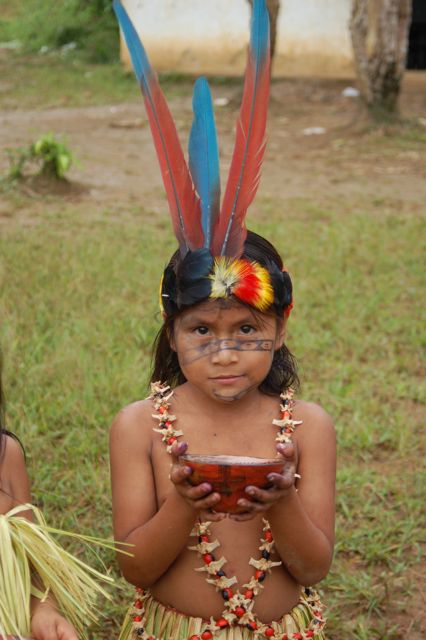
For now though, how about more images from our work with the indigenous...and hopefully new studio work will soon follow!  (does anyone see a mucawa theme here?)


large chicha container with mucawas


Kichwa potter Rebeca Gualinga
     
Andoa girl
mucawa

Sunday, March 17, 2013

A delicate balancing act...

...outside of our own culture.  a blog post like this under the heading of work-in-progress?  Definitely!  While not about any studio work I am doing at the moment, it is still work-in-progress for me because it is part of my work, and deals with a research issue that has been on my mind for quite some time now.  And that issue?  Cultural Preservation... and how those of us doing research with indigenous people might affect change in the very work we are documenting and studying.

Over the past 20+ years now I have been doing research in the Amazon region of Ecuador (much of that time with colleagues Richard Burkett and Nan Coffin).  And during this time I have taken the perspective of one who observes, documents and comments on the clay work produced in the rainforest.  I do not see myself as someone trying to stop the inevitable cultural change that occurs naturally.  By this, I mean not someone who, observing that traditions are changing, or even dying, within indigenous communities (resulting from an array of reasons that cause this to happen), works to stop that change and therefore keep a craft tradition alive.  For me, the extent of trying to slow down any movement toward extinction comes only in the form of buying and documenting their work, hopefully adding support to their current efforts in clay.  In short, I prefer to be the one peeking in through the keyhole in the door of another culture to see what is happening.


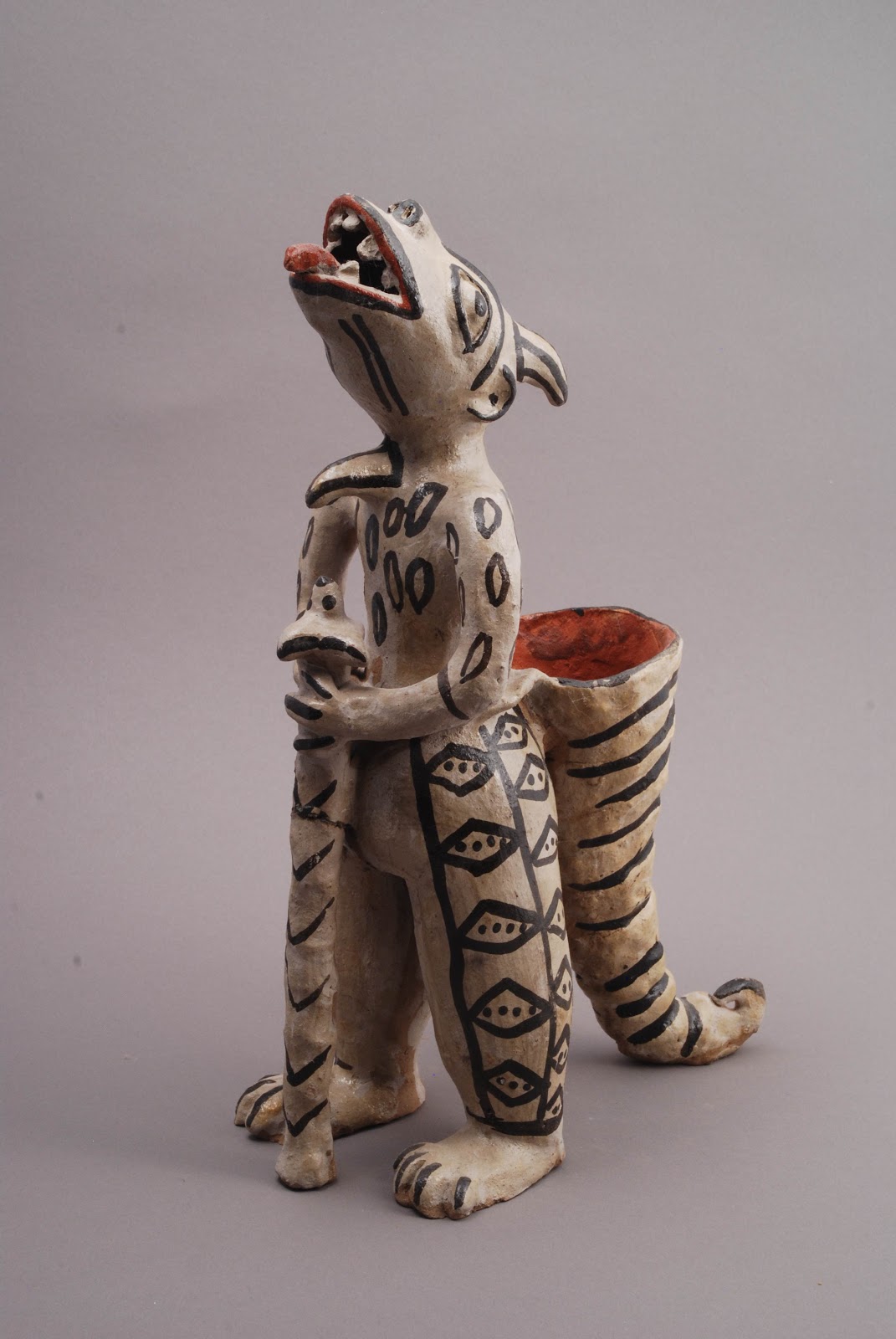
But the real question I have for any of us engaged in this type of work is this:  How do WE affect change in what they produce, through the presence in, and the study of, cultures other than our own?  An example for me is when I was visiting an Amazonian Kichwa potter one day who I have known for years, only to discover that a ceramic figure she had made (a Juri-Juri, a protectorate of the indigenous) that was sitting on the shelf, was made in my image.  While this was meant both as a compliment and a bit of humor, the image caused me to be reflective on how my own interaction with this potter over the years had inspired her to alter the traditional image she had in her head of the Juri-Juri.  As I thought about it more, and after several years of returning to the rainforest to meet new potters as well as ones I had met in previous  trips, I found myself becoming increasingly aware of my own footsteps into another culture and how my interactions might affect the direction of their work.


Hmmm, a lot to consider, for me anyway, and perhaps for others too, especially anyone stepping outside their own cultural landscape to study the work of indigenous people.  The questions are many, and the answers few.  With this in mind I put together a panel presentation for NCECA in Houston later this week, one that addresses this issue in hopes of gaining a broader perspective on the question.  Invited panelists Doug Casebeer (presenting his work in Nepal, Chile and Jamaica), Winnie Owens-Hart (Ghana and Nigeria), and Richard Burkett (Ecuador and the Amazon), will comprise a roundtable of discussion on these very issues, allowing me to present each of them with questions on the topic.  While I don't really expect to find the answers just yet, I am happy to be asking the questions.  Something I feel important for our field of study, especially in a time when access to remote locations has become easier than ever before.


Anyone at NCECA interested, I hope to see them there!  In the meantime, here are some images from the Amazon that might help present a sense of place and people that represent a particular traditional landscape, and provide reference for the very questions with which I am struggling.


Dog figure


Juri-Juri


Shiwiar Chicha Pots

Huaorani potter


Wednesday, March 13, 2013

The sound of silence...

...is deafening!  Seriously.

Having been without a voice for the past week (and thankful I have been released today and am now speaking again), has been a most humbling experience.  It is amazing how both listening and speaking changes without words, or at least the sounds of words.  Sure, I was prepared to write notes to others when I wanted to say something, but honestly, what I discovered was that in doing this, I took more time to think about what I wanted to say, and often decided I really had little I wanted to say.  The simple effort of writing out a comment makes one become more introspective (or is it self-editing?), and in doing so, I became more tuned in to the value of each word or thought I wanted to say (or rather, write).  Sort of funny/strange really, and the only thing that kept my spirits up was the notion that the silence would soon end and I would be allowed to once again speak.  But it did give me plenty of pause for thought about people who cannot speak, and what daily life is about for them.  You start living inside your own head, or rather thoughts, and you start to hear/listen more attentively to the world around you.  And even more curious is how others interact with you if you cannot speak.  They treat you differently!  While on the surface it appears kind, it is not necessarily better.  Don't get me wrong, the intentions are always good, but the actions are still different.  It helped me realize how much our thoughts and actions are tied to our words and how we express them to one another.

It all brings me back to what my blog is ultimately about, or hope it to be about.  You see, for me it is a diary, capturing my thoughts about my work in clay, art, travel, and so many other life experiences that come along.  My commitment to it is to be consistent and honest, regardless of the many times I feel lazy, or trite.  The only difference here is that through a blog I also invite others to look over my shoulder as I think out loud.  I tend to believe I am not covering anything new or profound, yet my thoughts and feelings about life and art are real, at least they are to me.  And if they are of interest to anyone else (which it surprisingly appears they are!), well...I guess I am not sure what to say about that.  But it may underscore that we, as humans living in the 21st century, do share many of the same fears, joys, family concerns, experiences, etc., and by sharing them with others we simply confirm our own humanness.  And more so, we are not alone, even when in silence!  Striving to find a way to say this through my clay work remains the challenge in front of me each day I am in the studio, and that challenge, as difficult as it may seem at times, is ultimately much easier to accept than the challenge of living in silence.

As I mentioned in the last post, no one gets out of this alive, yet we sometimes carry on each day as though we will live forever.  Recent experiences with health issues have at least confirmed this for me.  I now know of two things I am certainly sure of:  one is that I will not be elected the next Pope, and the other is that life is finite!  The trick in the latter is to look at each day anew, and make the most of it, and limit yourself to being unnecessarily exposed to the negatives in life that can so easily create decay in our days.  With this said, I hope to find the courage needed to discover the personal relevance in the things I make in the studio, and not fear the failures that seem to sneak in as well.  As a result, and in keeping with the posting of images from the studio for work-in-progress, I present both new work in the form of serving bowls in trays (thinking of a variety of foods eaten together, with family or friends, while thoughts of things utilitarian permeating my thoughts), and failures, in the form of pieces blown up in a recent bisque firing.  And with all I have experienced lately, the blown up pieces were the easiest for me to accept in the course of my day.  Crazy, huh?  (although I am not suggesting I would easily get used to that happening!)  The real threat to ones work is not in the failures, but rather in the absence of time in the studio.


Friday, March 8, 2013

A conundrum...

as defined by Webster's is 'a confusing or difficult problem'.  I guess this is where I find myself, and where I will start this blog post.  For you see, I have just had surgery on my voice box and am left silent, at least for the short term.  The medical issues surrounding me are perplexing, and without getting into too many details (at least not just yet, maybe later in another post as I learn more and see how things unfold), suffice it to say that I am approaching my studio work differently than before.  And here is where I wish to begin...

I have always stated that artists, and for those of us that are potters, should 'touch clay every day'.  Now I realize this is hampered by many circumstances that deny our ability to complete the task of touching clay every day.  But you know what I mean, I hope, when I say this as it is meant to imply that we should be in contact with our work daily, in some capacity.  I prefer it to be in the studio of course, but sometimes it is in writing, travel, conversation, reading, teaching, etc., all of which, for me at least, helps support my claim of 'touching clay every day'.   But the real claim, in times like these, when you are consumed with a personal issue that distracts ones thoughts so much, is to find your way back to the studio, despite the distractions.  Health issues are the ones that come to mind, for where are we without our health, and especially good health.  The distractions are mind-boggling, especially when they are your own.

I like to often say that 'no one gets out of this life alive', but the reality of that is comforted when you think you will have a million tomorrows.  How is it for those who know they won't?  What do you do then, and how do you prioritize your life?   My brother Ken, a Catholic priest, tells me no one should ever think of tomorrow that way since God does not give us tomorrow, only today.  Yesterday is gone and not to be changed, tomorrow may never arrive, so living for today is the only thing one can really count on.  Sounds good, but still... Now,  don't get me wrong here, I am not planning to leave anytime soon, at least if I have anything to say about it.  But still, a health issue that sidelines you like no other can certainly give you pause for thought.  I have been medically tested over the past four moths enough to make me feel like a lab rat.  And a couple of minor surgeries later (yes, minor, at least that is what I claim them to be since I did not have to stay overnight, even though I know better) I am still hoping for something that makes me feel more confident about the many tomorrows I plan to have.  So, about this art making thing...

I have mentioned before how I find courage in those artists who can work through difficult times, be it, health, war, emotions, persecution, or any such thing that would make going into the studio a challenge.  Sure, art can be the thing we use to vent these feelings and express where we are with it all, but really, it is not all that easy. Still takes courage.  So my challenge, is to walk those steps to my studio and find my voice, that has now been temporarily made silent through speech, within the work I make with my hands.  What do I want to say in clay, and how is it different from what I might say with words?  And after all, shouldn't they really be the same voice?  If not, why is one saying one thing while the other is saying something else? Maybe the courage I am seeking is not so much to physically walk to the studio as much as it is to confront the ideas I need to say that reside in my being, yet denied out through my hands?  How to make your work your voice, when you really do not have one?  Courage...and a lot of making of things, good and bad, that come from deep within yourself.  It can be done, and hopefully within the lifetime we are given. One day at a time.

To be consistent with offering an image or two, (I guess this is something I am committed to if indeed I am posting about work-in-progress, even if now I am looking at it more as life-in-progress...hmmm, a new title?).  Here are some stacking bowls I have been working on, early in development, but fun to do.  Sort of a diversion, so let's see where they go...and another of some slip cast vessels that I see as a wall installation.  I'll need about 50 to have the idea complete.  Working to stay focused...!


Friday, February 22, 2013

Sometimes it's easier...


...and sometimes it's not.  Starting a blog to talk about work, art and travel seems easy enough, after all, each of those things bring on so much thought and reflection.  But the reality of it is sometimes the work gets muddled in confusion, brought on by conflicts within the work, or simply life in general.  The hardest part is to keep moving forward and hope that things become more revealing as more work is produced.  While I sort through the difficulty and relevance of what it is I produce, coupled with a health issue that is nagging me, and then the daily distractions resulting from being part of an academic community, how are they inter-related, or perhaps totally separate?  I have always admired the artists that work through anything that is in their way, and have the courage they bring to their work through this perseverance.  But really, it is not that easy.  And when I see how our own culture can sometimes value (or is it de-value?) the arts, I am reminded of how much the visual and performing arts add to our lives.  After all, when you walk through a great museum, you see the work of artists.  We remember those in the past who captured the spirit or cultural ethos of a particular people, place or time.  Do we remember the power brokers from that same time in the same way?  I doubt it.   While we may want to trivialize the arts, they are the thing that perseveres, nourishes, and lasts.


Sorry to ramble on here, but with all that I see going on around me, I only wish it were easier...


Here's a couple more images from the series I am working on (among other things in the studio), that are still connected, for me, to the great pre-columbian pots I am looking at.  I hope to somehow distill what I am seeing with what I am feeling.  I plan to post some pre-columbian pots soon so there is a more direct visual reference to what it is that touches me so directly.  The real trick is to look, absorb, reflect, and innovate, in a most personal manner.  Boy, I wish it (art and life) were easier...


Saturday, February 16, 2013

invention versus innovation...


I've been thinking about this a lot lately as I work on some new pieces.  I spend a good amount of time looking at what I am making and thinking about where the ideas come from and what they lead to, which is why I titled this post invention versus innovation.  Seems while they are both related, still very different nonetheless.

Not sure where my thoughts on this began, but wouldn't be surprised if it came from long ago, like grad school days (a very long time ago) when studying with Harris Deller at SIU-C.  Harris was very good at asking the hard questions, and as I have moved through my career as a ceramic artist, I continually realize how much he helped me formulate the questions I needed as I probe deeper into what it is I make and who I am as a ceramic artist.  I think everyone needs a person in their career path that helps them sort it out, and Harris was certainly that for me.  A very good teacher!

But back to invention and innovation...

I recall years ago a comment from David Hamilton, professor of ceramics at the Royal College of Art in London, who I met after he had just returned home to London from the U.S. (while we were living in London briefly ourselves).  When I asked what he remembered the most about clay in our country, he commented that he thought everyone seemed to be trying too hard to be unique.  That comment stuck with me, and over the years, when I think about it while working in my own studio, or looking at the work of so many others, realize he is right.  But I think he said it in a bit more pejorative manner (thinking we ignored, or didn't care about the past, only wanting to be recognized in the world of ceramic art).  Whereas for me (and I am sure others as well), I am just scratching around at the sand (or is it clay dust?) looking for a new way to see things that were already familiar to us.  Is that really bad?  I don't think so.  And with regard to invention versus innovation, I think it is the innovation that I care about the most.  I love the history of pots and clay, yet my voice is probably realized more by adding to that vocabulary rather than re-inventing a new one.  Maybe?

I tend to think of artists like Picasso, who 'invented' a whole new way of seeing (Cubism) as what invention really is.  Or closer to home, maybe Volkous, who invented a whole new way to look at pots.  For me to cut a piece in half and rearrange it has been made possible through what Volkous did, but that does not mean copying at all, but rather digging deeper into the meaning behind this new way of seeing pottery forms.  Innovation?  Maybe?

And then there are those great writers and painters in history.  Gertrude Stein, for example, did not invent language, but what she did with words was true innovation ('a rose is a rose is a rose'...not really about a rose, but more the sound of the word in repetition).  And painters who painted views of the landscape (Van Gogh, Bonnard, etc.).  Why do it if it has been done before, and especially now since we have cameras?  Well, for me, I think these painters saw the landscape different than anyone else, and wanted to make that a reality for themselves and the viewer.  Not inventing the landscape, just innovating a vision of it.  Same as someone wanting to share their vision of what a pot (vessel) is, not trying to invent anything new, just innovate on what is already there.  Maybe?  Yes!  Invention versus innovation, and it's place within the context of my own work.  Something for me to keep thinking about as I make new work.

Anyway, here are a couple of images of new work in-progress, using the present to influence my understanding of the past.  One is a cup and saucer with handle, and the other a pre-columbian inspired vessel.  Enjoy (or not)!


Sunday, February 10, 2013

random thoughts...


While working in the studio the last few days I saw postings of pots on FB from people showing what they believe to be 'treasures'.  I found myself wondering about how they became 'treasures'.  I recall seeing a piece that I simply thought was not that good, yet so many people responded with likes and comments stating how much they loved it.  It all got me thinking about where is taste developed?  Is the golden rule really golden?  How many people have to agree that a piece is good for it to exist as something meaningful in art?  Do we often check the 'like' box of appreciation simply because others do?  And while we might say they meet certain established standards, who set those in the first place?  How far back do we go to find the person, or culture, that had the answer we all now accept as aesthetic truth?  And if we do think we found the answer to what is good and bad art, who do we know that has ALL the answers so we can check to see if we (or they) are right?  Very confusing.

I still do not like the piece I saw posted on FB, even though many others thought it was good.  For me, it was not.  And if I really care to find truth in what I create, I must also find the courage to stand up to those pieces that simply do not work for me despite others making claims to the contrary.  I only hope I can remain open to the possibility of change in both my understanding and appreciation of what I see within the world I live.

Boy, this title, random thoughts, sure fits!

I am posting a couple of in-process images here that are quietly speaking to me.  I do not own them completely as they are the products of what I have seen in the study of other cultures outside of my own, as well as thoughts on faith that come through a lifetime of reflection.  I find it a slippery slope to try and identify feelings in my work about spirituality and faith in the face of all the religious hoopla around us in society, most of which I find extremely troubling.  Still, I hope to have a thumbprint on what I create, while paying homage to the work that resonates for me in a most personal manner.  And I am not troubled by others not 'liking' all the work I create, for when art becomes everything, it also becomes nothing.


Tuesday, February 5, 2013

studio time...


Keeping work going the studio is the key.  Doing something, anything, to keep the work moving along.  Touching clay every day is important, and not worrying too much about making anything important, just keeping your hands and head in the work.  Hopefully pieces will eventually speak for themselves.

Ever made anything that you really did not understand, and then with time, it became apparent?  What does that mean?  Are we really ahead of ourselves?  And if so, what if you make something that you think is really good, only to discover later that it is crap.  That happens, unfortunately!  But I think making crap is part of it all, and can be informative, in a way.  But still...yet I am still intrigued with the intimacy of space, and the quiet reflections back to something that might have a spiritual reference.

Here are a few pieces that just arrived. but not yet finished.


Sunday, February 3, 2013

speak up...


Well, I'm here...finally.  Been wanting to do a blog for some time now, and seems as good a time as ever to jump in.  While I am not real sure the direction I want to take it, I do know that keeping a diary, or a blog in this case, is like talking to yourself, (with others peeking in over your shoulder), so my thoughts on my work in clay, travel and art are items I will want to re-visit regularly.  And the idea of taking 'working' photos of pieces I have ongoing in the studio is exciting. Seems the pieces I sometimes make never quite make it to the end as finished work, yet the ideas they contain, and ideas I see in them along the way, are still too important to ignore simply because they never make it out of the kiln.  So, I hope to capture some of this 'in-process' work, and maybe others who drop by will share some insights about them as well.


So for now, here I am, and my commitment to this blog is to not ignore it, but keep it current, as best I can, even when my thoughts are hard to define.  I'll post a couple images to start off, and let's see where it goes.  BTW, the first one is influenced by some pre-columbian work I saw a while ago, and I love the integration of disparate parts, and the second, well, some thoughts on religion and faith seem to circle around this piece, and others I am doing now, even though I feel very unsure about what they are and what I want to say.

See you later...