Monday, April 22, 2013

My cup runneth over...

...well actually, I am at least trying to keep it partially filled.  But in thinking about cups, I find myself preoccupied with some thoughts about them that have been on my mind lately.

You see, for me making cups has always been part of what I do and make.  Sometimes it is like doing ceramic aerobics...using cups to help jump start the making process both physically and creatively.  I do love functional cups though, which I often make and are surrounded by and use daily in the home.  But honestly, I often get sidetracked making cups that soon become more visual explorations into form, surface and idea (dare I call them 'sculpture'?).  What a great way to wonder within ones work, without straying too far from the ideal cup.  It seems many artists do it, I think, both in clay and other mediums.  There is something about the cup form that draws us in, or maybe it is because we all understand it, and since it is part of most everyone's day, it is a safe form to explore both within the range of function all the way to any sculptural idea that may present itself.  From the wonderful functional cups made by so many potters today (too many to list here), to ones like the sculptural cup of Brancusi, made of solid wood and extremely large, the cup form resonates so well for us all.

I recall years ago drinking water from a stream with my hands cupped to contain the liquid, thinking how natural it is for us to physically identify with a drinking vessel knowing it started from the simple act of holding our own hands together.  And, sharing beverage with one another using the same cup, as one does in the tea ceremony, or around the kitchen table, allowing the cup form to become an intimate object used to foster a type of communication with one another.  So what better object than the cup to use as a 'connector' for humans, both through its ability to function to its power as a visual metaphor, therefore serving as both utility and art.

But let's look at another aspect of this, and that is to have the cup become a type of legacy from one person, or one family, to another.  I am speaking here of the cups we use daily, perhaps a favorite cup that is special to us for a variety of reasons.  It could have been received as a gift, or something we obtained through an event, experience, or whatever.  Regardless, a cup, any cup or cups we own, have the potential to carry with them a myriad of feelings, experiences, memories, uses, etc., and can each begin to define moments and individuals in our lives.  And let's be honest here, it is not inconceivable that those same cups we use from day to day (if they do not get broken along the way), may outlive their owners, and as a result get passed down from one person, or one generation to another.  I'll bet most of us have pots that were once owned and used by our ancestors, and as a result we hold them dear and are reminded of these people each and every day we see, hold, and use them in our own lives.

So, I do believe that the cups we make that are passed along to others as gifts, through sales, or whatever, hold the potential to become part of a family history, and therefore serve as legacies of who we were in a particular place and time.  While I am not suggesting we think too hard on it all, I am suggesting that we think some, and care enough to put ourselves into any cup we make, for any reason we make it, knowing it may one day become part of a person, or family legacy, far from the maker itself.  

One last thought, and I admit a crazy one, is that I am contemplating posting a cup a day to my blog (no commitment yet, only a thought I am considering!). I would love to see what might come from it, and allow me to share the cups, or ideas of cups, I see as part of my own life.  Might prove interesting to observe how my own thoughts about cups might evolve.  Not necessarily limiting them to clay either?  Hmm, a thought.  But one a day, for how long...a year maybe...am I nuts? Sure, so we'll see if I can talk myself into taking the plunge!

For now though, here are some cups being made in my own studio, along with the Brancusi wooden cup I love so much!


functional cups


sculptural cup and saucer


Brancusi's wooden cup


Tuesday, April 16, 2013

I wish I knew...

...what to think or say after hearing about the tragedy in Boston.  But let me try to wrap a few words around some feelings...

You know, I had been mulling over a new blog post about pots, again, when news of the Boston Marathon tragedy hit the airwaves.  At first I thought here we go again, another senseless tragedy, and for what?  And now, a day later, sitting down to think about a new post on pots, I read yet another story about tragedy, heroism, and the glue that makes people stick together in the most difficult of times.  Stories of how people helped one another, and stories of how lives are indelibly changed forever.  Senseless, for sure, and still heartwarming to hear and see the good emanate from strangers, family members, and so many others, in Boston and beyond, who will also find that day has changed them as well.  

You see, it seems that while the person responsible has done something unimaginable to most, what we are now left with is the truth of humanity and real examples of what it means to be alive and to care for one another.  Sure, it is indeed senseless, and the first reaction is to find the person responsible and make them pay the highest price for what they have done.  But through it all I cannot let go of the feeling of warmth and caring I see on the streets of Boston.  How people share the pain and care for strangers, doing all they can to help one another.  I see more stories of caring and love than I do of revenge.  The most recent story I saw in the NY Times (http://www.nytimes.com/2013/04/17/us/in-grisly-image-a-father-sees-his-son.html?smid=fb-share) made me want to weep, both out of the sorrow I felt for the victim as well as offerings of help from strangers who stepped up in such a dire circumstance.

So, today I initially want to say my thoughts are about neither pots nor art, but in some weird way, I think they still are.  You see, for those of us making art every day, we only hope to connect to others and share parts of our lives that we hold dear.  Lives that we know are fragile, and temporal.  Sharing who we are through art, becoming vulnerable to our own human existence, and allowing it all to connect us to one another on the most human level is indeed a noble act.  I want to say that nothing I have ever done compares to the noble acts of kindness and generosity I have seen on the streets of Boston, but if, in some small way, we can each share a moment of kindness and generosity to one another through what we do and say through our art work, it mutes the acts of a few determined to speak loudly through their negative actions toward others.

It is all so confusing to me, and I only wish I knew better what to say or think, but my most primal thoughts on yesterday's events are sure to remain with me as I go to the studio again to touch clay.


Friday, April 12, 2013

Objective Clay...

....which could, by definition, refer only to the objects presented?  But is there more to be mined from this collaborative project?  I tend to think so...

This post comes from seeing the recent release of the web site Objective Clay (www.objectiveclay.com), which is the product of a group of young potters brought together through the recent Arrowmont Utilitarian Clay VI conference. Friends Peter Beasecker and Bill Griffith, the organizers of this symposium, strayed from the traditional mix of artists from previous events, those being a mix of young, mid-career and seasoned veterans, to this time around bringing a group of young emerging artists together for the symposium.  A great move on their part as it presented some young talent, fresh ideas and new energy. And, resulting from this experience being brought together as a group of young presenters, if I understand it correctly, they pledged to remain a group after the conference, and now they have presented a web site of their work.

What a great idea, and knowing several of these young artists I can attest to their devotion, skill, knowledge and passion for working in clay.  A great concept to lay the groundwork for a new generation of potters and setting a direction for new work, discourse and attitudes in contemporary clay.  The web site presents work for sale from the members of this group, with a couple of short essays by Peter and Bill. All told, it is a clean and professional site that, with time, may offer great insight in presenting ideas and work by some of the younger members of the clay world.

I think this site will only continue to grow and improve.  More work added to the site for us to see will be a good addition, and even reading thoughts from them about how and why they work in clay will be something to look forward to seeing in the future. One of the observations I particularly liked, from Peter's essay, was by Mary Barringer, when she commented on the discussion of the careful selection process of these young artists, she said "make sure they have something to say".  And I believe they do!.  But it is a beginning, and a good one at that.  I am proud of them all and look forward to seeing how they will continue contributing to the contemporary clay landscape in front of them.  

So, I recommend anyone reading this post who might have an interest in the future of contemporary clay work to look at this site (www.objectiveclay.com).  It shows great potential.  Their new website will mature, I am sure, as I have faith in them all and love what they are trying to do together to help shape the future of our field.  And really, there are so many other young artists out their too that need to contribute to this dialogue and direction, so hopefully their voices will be heard and their work will be seen.  But what a great start here with the birth of Objective Clay!


Monday, April 8, 2013

The real and the not-so-real...

...or I guess I mean, the real and the digital...in a rapidly changing world.

A few thoughts here that came to me after reading an article by the art critic Jerry Saltz (http://www.vulture.com/2013/03/saltz-on-the-death-of-art-gallery-shows.html).  An article on how galleries are struggling, and the one aspect that stuck with me being a result of the Internet and the role online galleries play in the marketplace of art and ideas.  There is a lot to cover in this article, so I wont re-hash it all, but the point that I am left contemplating is how the Internet has changed the face of art and its audience.  And while it is easy to jump in on either side of that debate, with one deploring how art (clay in my case) is so often viewed as only a 2D representation of a 3D object; or the other side, in saying it has leveled the playing field making objects so much more accessible to everyone who has a computer (and who doesn't these days?), I don't think the discussion, or debate, is really that black and white.

Saltz talks about the importance of seeing art in galleries, and how that helps us formulate our opinions and foster a conversation about what we are seeing in the real world and in real time.  This is certainly true, and if I lived in NYC, LA or Chicago (or any other art center around the world), I would tend to think the absence of the gallery scene might be a loss too great to imagine.  But what about the rest of us, those of us rowing quietly in the cultural backwaters of society (and this is not to imply anything pejorative here as honest looks into culture are so often found in those places).  The very idea that I can experience art via the Internet certainly does create a more level playing field in what I know and see.  And after all, in the past (before the digital age), it was magazines in print that delivered the newest work to my doorstep, in 2D, from shows of artists far away from where I lived, meaning I was not always seeing clay objects in the real anyway.  The difference now is that I can see things as they appear at the same time as others in the big art centers around the world, albeit still in 2D (that is also changing!).

I remember back in the early 90's when I started the Clayart Listserv for ceramists, living in a more rural environment I was looking for a way to be more 'connected' to the clay world on a regular basis.  For me, it made a huge difference to be able to share ideas about clay with people from around the world, almost in real time.  And while images were not part of that format, the discussions were lively and new connections were made possible, and immediately.  Of course, Clayart continues today even though I passed it along to Ceramics Monthly in 2000, and since then, more electronic venues have presented themselves and added more to the digital dialogue that continues today. Saltz talks about missing the 'conversation' that is a vital part of the gallery scene, through openings and other meetings at shows.  But really, are these 'conversations' lost through the Internet?  Not sure. Clayart alone, at least in the early days, provided a great deal of grist for the (ceramic) mill and discussions were often lively and thoughtful (not sure these days as I do not follow the list regularly).  But the idea that the loss of a meaningful gallery scene equates to a loss of a meaningful 'coversation' on art seems narrow in scope, at least to me.

But, on the other side of the issue, when comparing traditional galleries to on-line venues (can I still call them galleries?), have we really made progress?  I guess it sort of depends on what we call 'progress', don't you think?  I say this because sure, on-line galleries (or any other electronic means of showcasing one's work) does allow for a more level playing field with regard to people having access.  I mean really, now your work can be seen by anyone with a computer, and your audience is not limited to those locations where good, traditional style galleries exist (and I have not even mentioned accessibility to web sites!).  But it also means everyone has a venue for showcasing their work, and in many cases, without regard to the quality of that work.  As I said in an earlier post...when art becomes everything, it also becomes nothing! So while we have this tremendous access to work from around the world, where and how are standards being applied?  And for that matter, who creates the standards in the first place?  When traditional galleries present work, I guess we rely on their knowledge and keen 'eye' towards presenting the best.  So now, through the internet, we need to rely on...?  Hmmm, makes you wonder, right?

With all this said, there are certainly good places, at least for me, where I look to see good work in clay.  Access Ceramics is one, and I love it because it is not a sales room, only a place to see good ceramic work.  For sales, AKAR does good shows, along with Schaller Gallery, Charlie Cummings Gallery, etc., not to mention other less commercial gallery/more community based venues such as Red Lodge, Lill Street, etc..  Oh, the list goes on and on, and I'll bet anyone reading this could add another name (please do!) to a growing list of credible clay spaces that function primarily as on-line galleries.

In the end, I am glad to have ANY access to looking at clay, be it in-person, through the Internet, or print magazines.  They all still play an important role for me, and I am sure many others as well.  But as magazines move toward on-line apps (like Ceramics Monthly just has), and the digital age gets more and more sophisticated, the future for following clay art is obvious.  How many of you have already thrown out your old clay magazines?

A few sites worth checking out, but we all know there are so many more to list:


Wednesday, April 3, 2013

Why pots?...

...or maybe better still, why not?

Pots, especially pots that are utilitarian, are, simply put, lovely to touch, hold, use and have in the home.  This thought came about recently with an article I read about a show of bowls at the Portland Museum of Art, along with information on the show that was published in the NY Times (titled..."Finally, the Bowl Gets Its Due" - nytimes.com) and then widespread across the Internet.  A lovely concept and equally provocative exhibition, highlighting the quiet, yet powerful place the 'bowl' plays in our lives.  I will take this one step further, and also say the quiet, and provocative place functional handmade pottery plays in our lives.  A posting on FB by my wife, Mary, captured it all when she said "Do you have a favorite bowl?  If not, you are not getting your dishes from a potter".  Well said, but then again, she lives in a house full of pottery and uses them every day, in every way.  But still...I think she's right, if you don't have a favorite bowl, well, you know.

It all made me pause and start to think more about the things I make in the studio, and their connection to the pot, or rather, the utilitarian pot. Now understand, I do make functional pots from time to time, but I never claim that as my main work.  I would love to, but I get so easily sidetracked seeing the pot/vessel form in the abstract, and how ideas of function work on so many levels.  The spirituality of functionalism is of great concern to me, and because of this I so easily stray from the pure utilitarianism of pottery forms.  Don't get me wrong, I am not saying what I am doing with pottery forms is not good, and for me, it is essential.  You see, I cannot help but see the pots I make as abstractions of ideas that are contained in the forms that have their roots in everyday pottery.  While I started with a background in functional pots, and even had a great experience doing an apprenticeship at a pottery, it has always been the 'what if' of functional forms that intrigue me.  But in the end, I am most comfortable working with the pot/vessel form, and I often think it is like an umbilical cord that keeps me tethered to the roots of what I love...the pure functional pot that one can use every day.  And while there is a lot of sculptural clay work out there today, and much of it very good, I just can't seem to disconnect myself from the pottery forms I love, even as I stray away from pure functionalism.

So, I guess what I am saying is that the pieces I am making now are more connected to functional pottery than previous work I have made, yet they are still not the most 'functional' of forms.  Can it be?  Hmmm, I just can't seem to help myself seeing pottery forms in a way that take me on a visual journey (not to say pure functional forms cannot do this, and they indeed do).  Yet for me, vessel abstraction is still part of a pot being functional.  How many levels of functionalism are there anyway? Boy, I hope I am not finding excuses (sometimes I think I rationalize things in a way that would make Freud turn over in his grave!), and if you are confused, think how I feel. But thinking out loud may help me work through the ideas I have that are ongoing in the studio, and in the bigger picture, what's really more important is that there is work ongoing in the studio.  Just make stuff!  It will all make sense some day (he says hopefully!).

But as for functional pottery, and for those of you who do it so well, you are my heroes! 

Here are a some images of some ''work-in-progress'!


pierced vessel


Slab tray with thick slip


Thursday, March 28, 2013

Home again...

...from the NCECA conference in Houston.  And now busy trying to get time back into the studio, but first needing to get the article I have been working on with Richard Burkett on the pottery of the Amazon off to Studio Potter magazine.  Their next issue is titled 'Indigenous', and we are contributing a piece to it.  Good timing with us just having done a presentation at NCECA titled 'Indigenous Pottery:  Does Research Preserve Tradition?'  Not sure we answered any of the pertinent questions, but the discussion was lively and sincere.

Our article, titled 'Preserving Culture:  Evolving Traditions and Outside Influences Facing the Ecuadorian Amazon' has been an interesting thing to work on the past few weeks (and part of a book we will have out very soon on the pottery of the Amazon).  I look forward to the issue Studio Potter magazine will produce as it should present many facets on the topic of the indigenous.  Having studied the potters and the pottery in the Amazon for over 20 years, I am anxious to see what they put together for this issue.  The very term 'indigenous' invokes a myriad of thoughts for me, and I cannot help but think of it in political terms knowing how poorly the indigenous of the rainforest are often treated. It's crazy how those with the most, especially in terms of money and power, treat those who can so easily be marginalized.  To me it's a fairness issue, and all about treating others as you hope to be treated yourself.  Land and mineral rights in the rainforest, along with the religious pursuits of various groups, seem to invade the lives of those who are so easily manipulated.  In the meantime, lifestyles are disrupted, traditions are left behind, and the environment suffers.  So, we continue to document the ceramic traditions in hope they are at least kept alive through writing, video and oral interviews.  So,  preserving culture?  You bet, but only on one level.


I am looking forward to getting back to work in the studio, and being away from it for a week is quite disruptive.  Feels like trying to start a car engine in winter that has been left idle for a while.  It initially grinds and grinds, and then, hopefully, turns over.  I did get back in the studio today, and found myself staring at the pieces on the shelves and under plastic, feeling like a stranger who entered a party that had been going on for a while.  I had to look at the work, reflect on the ideas that they were trying to become, and try to merge my own thoughts with what they are now.  Sort of like trying to drive onto an on-ramp on the interstate, carefully giving it gas and hoping you don't get shoved off the road as you enter!  Luckily I was only away for a week...it's really hard when a week becomes two, and then three, and then a month or more. That merging process then is painful!


And good news from the medical front...and I feel like, at least for now until the next check-up, I dodged another bullet!  It's all so crazy sometimes, trying to live day-to-day, looking into the future with hope and excitement, yet reminding yourself today is really all you have for sure.  We all want more, but we should never trick ourselves into thinking we will live forever.  Ahhh...if only we could!  Maybe the people we love and the art we make are the only things that really will live on...?


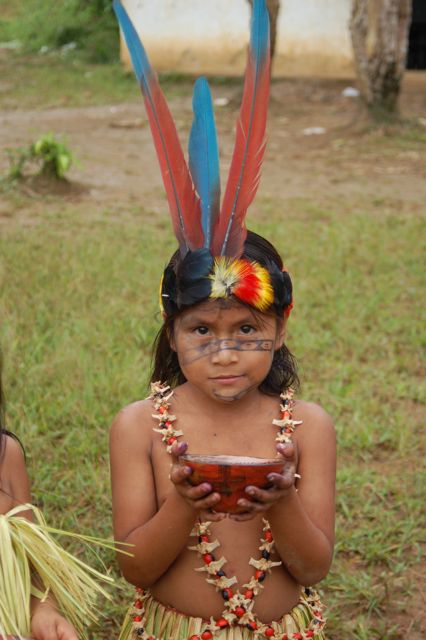
For now though, how about more images from our work with the indigenous...and hopefully new studio work will soon follow!  (does anyone see a mucawa theme here?)


large chicha container with mucawas


Kichwa potter Rebeca Gualinga
     
Andoa girl
mucawa

Sunday, March 17, 2013

A delicate balancing act...

...outside of our own culture.  a blog post like this under the heading of work-in-progress?  Definitely!  While not about any studio work I am doing at the moment, it is still work-in-progress for me because it is part of my work, and deals with a research issue that has been on my mind for quite some time now.  And that issue?  Cultural Preservation... and how those of us doing research with indigenous people might affect change in the very work we are documenting and studying.

Over the past 20+ years now I have been doing research in the Amazon region of Ecuador (much of that time with colleagues Richard Burkett and Nan Coffin).  And during this time I have taken the perspective of one who observes, documents and comments on the clay work produced in the rainforest.  I do not see myself as someone trying to stop the inevitable cultural change that occurs naturally.  By this, I mean not someone who, observing that traditions are changing, or even dying, within indigenous communities (resulting from an array of reasons that cause this to happen), works to stop that change and therefore keep a craft tradition alive.  For me, the extent of trying to slow down any movement toward extinction comes only in the form of buying and documenting their work, hopefully adding support to their current efforts in clay.  In short, I prefer to be the one peeking in through the keyhole in the door of another culture to see what is happening.


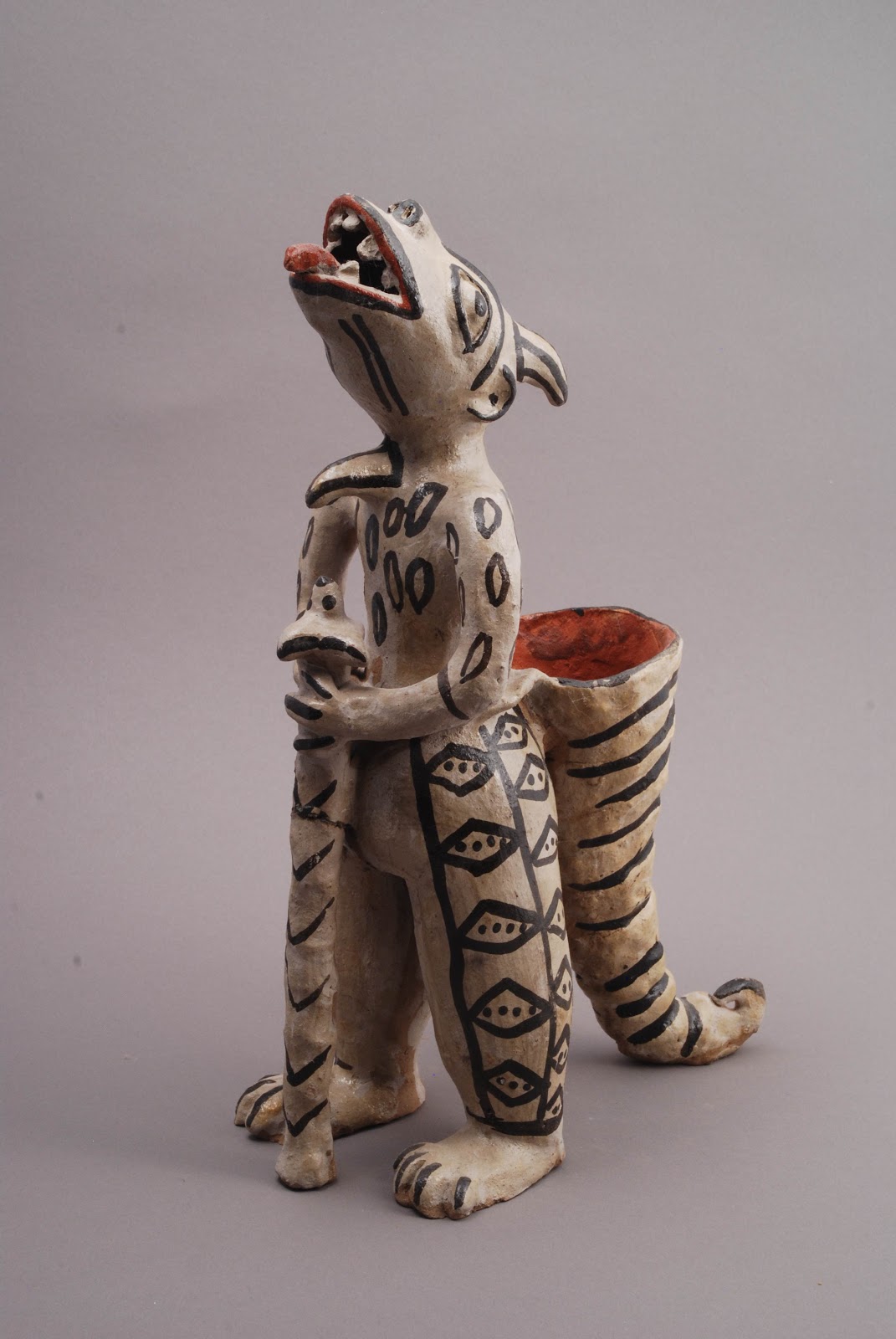
But the real question I have for any of us engaged in this type of work is this:  How do WE affect change in what they produce, through the presence in, and the study of, cultures other than our own?  An example for me is when I was visiting an Amazonian Kichwa potter one day who I have known for years, only to discover that a ceramic figure she had made (a Juri-Juri, a protectorate of the indigenous) that was sitting on the shelf, was made in my image.  While this was meant both as a compliment and a bit of humor, the image caused me to be reflective on how my own interaction with this potter over the years had inspired her to alter the traditional image she had in her head of the Juri-Juri.  As I thought about it more, and after several years of returning to the rainforest to meet new potters as well as ones I had met in previous  trips, I found myself becoming increasingly aware of my own footsteps into another culture and how my interactions might affect the direction of their work.


Hmmm, a lot to consider, for me anyway, and perhaps for others too, especially anyone stepping outside their own cultural landscape to study the work of indigenous people.  The questions are many, and the answers few.  With this in mind I put together a panel presentation for NCECA in Houston later this week, one that addresses this issue in hopes of gaining a broader perspective on the question.  Invited panelists Doug Casebeer (presenting his work in Nepal, Chile and Jamaica), Winnie Owens-Hart (Ghana and Nigeria), and Richard Burkett (Ecuador and the Amazon), will comprise a roundtable of discussion on these very issues, allowing me to present each of them with questions on the topic.  While I don't really expect to find the answers just yet, I am happy to be asking the questions.  Something I feel important for our field of study, especially in a time when access to remote locations has become easier than ever before.


Anyone at NCECA interested, I hope to see them there!  In the meantime, here are some images from the Amazon that might help present a sense of place and people that represent a particular traditional landscape, and provide reference for the very questions with which I am struggling.


Dog figure


Juri-Juri


Shiwiar Chicha Pots

Huaorani potter